


Book Recommendation: Rare Leadership
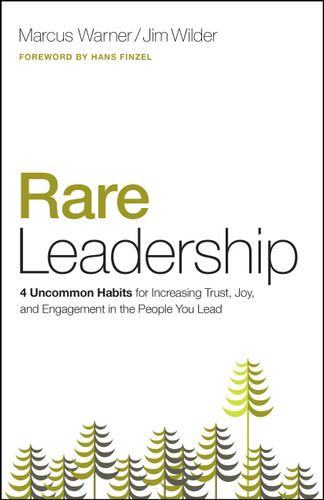
Name of Book: Rare Leadership: 4 Uncommon Habits for Increasing Trust, Joy, and Engagement in the People You Lead
Authors: Jim Wilder and Marcus Warner
What’s the “Big Idea”?
Rare Leadership: 4 Uncommon Habits for Increasing Trust, Joy, and Engagement in the People You Lead is a book that offers insights into four uncommon habits of leaders that can cause a dramatic increase in trust, joy, and engagement in the people we lead.
Rare Leadership is a book very much aligned with the way Max De Pree, our center’s namesake, valued relationships in the workplace. In his book, Leadership Jazz, Max stressed the importance of covenantal relationships as opposed to contractual relationships. Rare Leadership gives us the tools to create those covenantal relationships by leading from a place of joy and elevating relationships above problems.
This book helps leaders increase their relational and emotional maturity through four steps represented by the R.A.R.E acronym:
- Remain Relational
- Act Like Yourself
- Return to Joy
- Endure Hardship Well
Throughout the book, the authors share real-life stories that show the R.A.R.E. method helping leaders achieve emotional growth and spiritual receptivity in all walks of life. This method enables them to lead from a fast-track brain mechanism that brings awareness and places an emphasis on working from reason as opposed to fear. As stated in the book, “the brain uses a ‘fast-track’ (governs relational reality) process for relational leadership skills and a very different ‘slow-track’ (results and solution-oriented) process for management skills.”
Joy levels are important to keep the brain motivated. A fast-track brain works on creating joy in a team so that leadership skills can pass from one person to another. When the slow-track brain takes over, there is a decline in the levels of joy because the brain and the leader have switched to a results-oriented objective.
A continual return to joy is vital for the well-being of an organization. To build up group identity, an emotionally mature leader will use their fast-track brain to bring the group back to a place of joy. This is done by remembering who we are as Christians and once again focusing on relationships instead of results. Returning to joy does not mean getting rid of anger, but a mature leader will act like themselves and maintain their identity throughout an incident. We learn that putting the relationship first involves validating, offering comfort, and then repatterning.
Our joy can get drained, and that is why we need to reload to sustain it. Rare Leadership offers ways for leaders to do this while also remaining relational, acting like ourselves, and enduring hardship well. As we see in the New Testament, the key to enduring hardship is relational joy: “Though you have not seen him, you love him. Though you do not now see him, you believe in him and rejoice with joy that is inexpressible and filled with glory.” 1 Peter 1:8
Why It Matters to Our Life, Work, and Leadership
- Keeping motivation strong, fresh, and positive helps us recover quickly from the weariness that sets in and helps leaders guide others to keep a rewarding pace that allows them to add their creativity and energy to our mission. This reflects Max De Pree’s ideal of honoring the individual.
- All leadership positions will feel pressure both internally and externally in an organization. Building your emotional competence helps you lead under pressure.
- Relationships are bigger than problems.
- Burnout is typical of organizations led by results-oriented, problem-solving leaders. These leaders have a well-trained management brain, but often lack a well-trained relational brain.
Favorite Quotes
- “If I’m not experiencing peace, or the group I’m leading isn’t experiencing peace, it’s time to stop until we are all able to return to joy.”
- “If relationships are the root of joy, and joy is the jet fuel of high-performing teams, it follows that learning to remain relational is a key factor in creating high-performing teams and building healthy churches and organizations.”
- “Leaders can train this powerful brain system to produce full engagement in their team and develop a high level of emotional intelligence that keeps them plugged into a renewable, high-octane source of motivation.”
- “As leaders manage increasingly larger workloads and focus energy on better productivity, objectives, and results, they easily miss the decline in joy levels in their lives, families, and work teams.”

Trish Swords
Administrative Coordinator
Trish Swords brings years of administrative experience to her position as administrative coordinator at the Max De Pree Center for Leadership. For over two decades, Trish has fine tuned her administration and operations skills in the entertainment industry and has extensively served her church...