


A Basket of Summer Fruit
Scripture — Amos 8:1-6, 11-12 (NRSV)
This is what the Lord God showed me—a basket of summer fruit. He said, “Amos, what do you see?” And I said, “A basket of summer fruit.”
Then the Lord said to me,
“The end has come upon my people Israel;
I will never again pass them by.
The songs of the temple shall become wailings in that day,”
says the Lord God;
“the dead bodies shall be many,
cast out in every place. Be silent!”
Hear this, you that trample on the needy,
and bring to ruin the poor of the land,
saying, “When will the new moon be over
so that we may sell grain;
and the sabbath,
so that we may offer wheat for sale?
We will make the ephah small and the shekel great,
and practice deceit with false balances,
buying the poor for silver
and the needy for a pair of sandals,
and selling the sweepings of the wheat.”. . .
The time is surely coming, says the Lord God,
when I will send a famine on the land;
not a famine of bread, or a thirst for water,
but of hearing the words of the Lord.
They shall wander from sea to sea,
and from north to east;
they shall run to and fro, seeking the word of the Lord,
but they shall not find it.
Focus
Have we ever turned away from the poor and needy? Have we focused on our own luxuries? Have we been less than honest with others?
Devotion
The last time I journeyed through the prophetic books with you during Ordinary Time and we got to Amos, it was from a little earlier on in the book, but it was a similar passage. God is standing there with an object (in 2022, it was a plumb line in Amos 7), God asks Amos what he sees, Amos responds rather taciturnly “A plumb line” or, in this case “A basket of summer fruit,” and God uses that as a jumping-off point for a fairly strident prophecy. (Why a basket of summer fruit? The thought of many commentators is that, since it is summer, the fruit is ripe and soon to go bad; Israel’s chance to repent is going to be over before those bananas are ready to be made into banana bread.)
Amos spent most of his time prophesying against Jeroboam II of Israel (who was, to put it mildly, Not a Good Guy), and his condemnation of Jeroboam’s corruption is quite thorough. Here’s what I said three years ago about Amos 7:
It was because Jeroboam and his government and his cronies had failed to do justice that Amos, speaking for the Lord of justice, said that they would ultimately fall. Even though Israel’s rulers had kept the outward forms of faith, they had not seen to it that the least among them were well treated. So, God said through Amos, they would be measured (a “plumb line” is a carpenter’s tool that checks that everything is centered and lined up with gravity) and when they were found wanting, they would be destroyed. As I said—not exactly a cheerful devotional thought.
Amos 8 gives us more of the same and then some. This prophecy moves through basically the same stages as Amos 7, but it expands even more on the iniquity of the people:
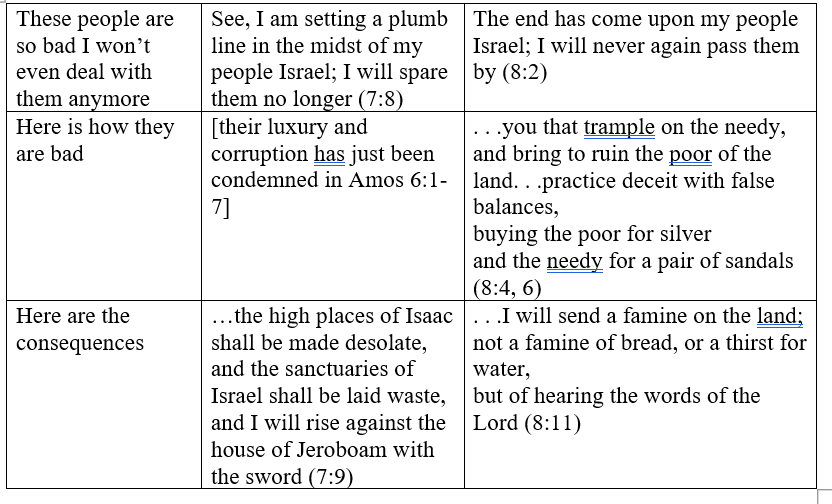
If you’ve read the Biblical prophets at any length, it won’t surprise you to see that what really upsets God in both these prophecies—as Amos relays the message—is mistreatment of the poor and needy. In Amos 6, which informs the “plumb line” passage, the focus is on the luxurious lifestyle of the elite and the rulers in Israel. In Amos 8, the focus is on their deceitful business practices. (As you can see in the full passage above, they even wait eagerly for the Sabbath observance to be over so they can resume cheating people.)
But what fascinates me about this passage most of all is the consequence. In Amos 7, destruction is going to come via sword, probably an invading army (which, about 25 years later, is exactly what happened). But in Amos 8, the people are no longer going to be able to hear the word of the Lord. The prophets will not speak to them. They won’t be able to grasp God’s wisdom from their holy writings. They will cry out to know what God wants them to do, and the heavens will be silent. I don’t know about you, but to me that almost sounds more frightening than an invading army. The summer fruit will have ripened, the basket will be gone, and there will be nothing but famine now.
If you know anything about C. S. Lewis’s The Magician’s Nephew, you may know that it is about the creation of Narnia, Lewis’s famous imaginary world. The creation actually happens about two-thirds of the way through the book, and some of those people who have come to be accidentally present at this world’s beginning—the boy Digory and the girl Polly, through whose eyes we see most of the narrative, and the cab-driver Frank who will become Narnia’s first King—marvel at the beauty of Aslan, the great Lion and Christ-figure of this world, singing Narnia into being. But Digory’s fearful and deceitful Uncle Andrew has a different reaction:
When the Lion had first begun singing, long ago when it was still quite dark, he had realized that the noise was a song. And he disliked the song very much. It made him think and feel things he did not want to think and feel. Then, when the sun rose and he saw that the singer was a lion he tried his hardest to make believe that it wasn’t singing and never had been singing – only roaring as any lion might in a zoo in our own world…And the longer and more beautiful the Lion sang, the harder Uncle Andrew tried to make himself believe that he could hear nothing but roaring…He soon did hear nothing but roaring in Aslan’s song. Soon he couldn’t have heard anything else even if he had wanted to. And when at last the Lion spoke and said, “Narnia, awake,” he didn’t hear any words: he heard only a snarl.
Later, when Aslan tries to help Uncle Andrew, who is after all hungry and tired and confused, he can do nothing for him other than put him to sleep. Uncle Andrew has clearly made himself unable to hear the word of the Lord.
And us? What about us? Have we ever turned away from the poor and needy? Have we focused on our own luxuries? Have we been less than honest with others? Have we tried to convince ourselves we are not hearing that soft, convicting voice that we really did, once, hear in the depths of our soul? Those bananas are getting awfully ripe. Perhaps we ought to listen to the prophet.
Reflect
Ask yourself the questions from the final paragraph of the devotion.
Act
I’ve talked before about my deep love for The Porter’s Gate, and as I think about staying the course and seeking always to hear the word of the Lord I am strengthened by their song “We Will Make No Peace With Oppression“ (or, if you prefer to see them actually performing it in concert, check out this link. The lyrics aren’t on either video, but they’re not too hard to understand.) Ask God—as the lyrics pray—to give you strength to always do what is right.
Pray
(Prayer for Social Justice in the Book of Common Prayer) Grant, O God, that your holy and life-giving Spirit may so move every human heart, and especially the hearts of the people of this land, that barriers which divide us may crumble, suspicions disappear, and hatreds cease; that our divisions being healed, we may live in justice and peace; through Jesus Christ our Lord. Amen.
Find all Life for Leaders devotions here. Explore what the Bible has to say about work at the unique website of our partners, the Theology of Work Project. Reflection on today’s Life for Leaders theme can be found here: God’s Justice Includes Work and Economic Justice (Amos 8:1-6, Micah 6:1-16).

Jennifer Woodruff Tait
Editorial Coordinator
Jennifer Woodruff Tait (PhD, Duke University; MSLIS, University of Illinois; MDiv/MA Asbury Theological Seminary) is the copyeditor of and frequent contributor to Life for Leaders. She is also senior editor of