


The Disciples and the Crowds
Scripture — Matthew 5:1-2 (NRSV)
When Jesus saw the crowds, he went up the mountain, and after he sat down, his disciples came to him. And he began to speak and taught them, saying . . .
Focus
Matthew’s gospel paints a picture of the difference between Jesus’ disciples and the larger crowds that followed him around to be healed and fed. While the crowds may be mere consumers, the disciples commit their lives to him; they sit at Jesus’ feet and listen to him, spend time with him, and seek to obey and follow him, even when the teaching is challenging.
Devotion
Today and tomorrow are my fifth pair of Life for Leaders devotions in 2025. Though Jesus’ Sermon on the Mount has not been the explicit passage for all of them, it has informed them. Recently, while preparing to lead a slow and in-depth Bible study working through the entire sermon, I returned to the introduction in Matthew 5:1-2 and was struck by a few observations.
Matthew notes that Jesus went up the mountain and sat down, that his disciples came to him, and that Jesus taught them. Although the first verse mentions “the crowds,” for several reasons I have understood them – the pronoun describing the ones Jesus teaches here, which appears in both the Greek and the English – as referring to his disciples. Grammatically, the disciples are the antecedent reference, the ones most recently mentioned before the use of the pronoun them. Second, Jesus has gone up the mountain, and only the disciples are explicitly said to have come to him. And third, Jesus was seated when he began to teach, which suggests a smaller and more intimate audience. Matthew 4:25 describes the crowd as a “great crowd” which has gathered from all over “Galilee, the Decapolis, Jerusalem, Judea, and from beyond the Jordan.” I think we are correct to imagine thousands, not unlike the crowds Jesus later feeds miraculously (see Matthew 14 and 15), which are numbered as five thousand and four thousand men respectively, plus women and children. Without a modern megaphone, it would have been difficult for Jesus to address such a large crowd, even standing up and projecting his voice as loudly as possible. Though certainly he could have miraculously made himself heard, sitting down suggests that wasn’t his goal. Perhaps he wanted to speak only to those who made the effort to come and hear him.
Now, if you read the entire sermon slowly and carefully (which is a great way to read it!), by the end you might forget how it started. However, if we jump to Matthew’s note following the conclusion of the sermon (Matthew 7:28-29), we read: “Now when Jesus had finished saying these words, the crowds were astounded at his teaching, for he taught them as one having authority and not as their scribes.” Matthew’s mention of the crowd’s response might lead us to suppose that Jesus was indeed addressing the crowds, and not merely the disciples – and that my earlier reading of Matthew 5:1-2 was wrong.
But I think there is a different and better understanding that brings together the sermon’s foreword and afterword: a subtle but important idea suggested by Matthew’s narrative. The two paragraphs of Matthew’s gospel immediately preceding the sermon introduce first the disciples (Matthew 4:18-22) and then the crowds (Matthew 23-25). Already this sets up a contrast. The disciples, we are told, leave behind everything to follow Jesus, becoming “fishers of people,” thus taking up his purposes as their own. We read more of this later in Matthew 10 when Jesus sends them out to do his work. And as Matthew’s gospel tells us at the end (Matthew 28:18-20), obeying Jesus is central to being a disciple. In the setting of the Sermon on the Mountain, when Jesus goes up the mountain, the disciples actively come to him, listen to him, and spend time sitting at his feet.
What do we learn about the crowds? First, we learn that they did have a chance to hear Jesus preaching throughout all Galilee (Matthew 4:23), prior to the Sermon on the Mount. Matthew also tells us that Jesus was healing people of all kinds of illnesses as well as demon possession, which increases his fame and seems to be a reason for the large crowds coming to him. If we consider this passage along with the feeding of the thousands, we might note that the crowds received material benefit from following Jesus. There is nothing wrong with that, of course, or Jesus wouldn’t have healed and fed them. Indeed, helping care for the sick and feed the hungry is a good way to imitate Jesus. It later becomes part of the work of his disciples.
So what do we make of the fact that some of the crowds were “astounded” at Jesus’ teaching. At some point – either during this sermon or at earlier times – they must have heard at least some of what he said. Yet we read nothing of the crowds actually obeying that teaching and joining Jesus’ work. Matthew seems to be painting a picture of one type of response to Jesus: folks having their needs taken care of while having an astounding experience of good preaching. If I were to put a label on this, I would say these large crowds had a consumer mentality. It is easy to go to church and be part of the crowds, appreciate a stimulating sermon from a pastor who knows how to preach well, enjoy some lively music from a talented organist or worship band, and benefit from whatever services the church offers – all without actually being transformed by the power of that message and committing to the work of Jesus. Being astounded by Jesus’ teaching is different from actually obeying it. Especially when the teaching is as challenging as the Sermon on the Mount. And maybe that’s the heart of the difference between the disciples who followed Jesus up the mountain, and the crowds who hung around.
Reflect
What does it mean for you to make the effort to go up the mountain and spend time sitting with Jesus and listening to him? Are there ways you sense God calling you to a deeper commitment? Where do you struggle to obey?
Act
Imagine Jesus going up a mountain. Follow him up, and spend time sitting at his feet and listening to his teaching. (You can do this by reading the Sermon on the Mount!)
Pray
Thank you, Lord, that we can still listen to your words today, even as Jesus’ disciples did 2000 years ago, by reading your Holy Word. Help us to listen not merely to be astounded, but to listen in order to understand and obey, and especially to listen to know Jesus personally. Amen.
Find all Life for Leaders devotions here. Explore what the Bible has to say about work at the unique website of our partners, the Theology of Work Project’s online commentary. Reflection on today’s Life for Leaders theme can be found here: The Beatitudes (Matthew 5:1-12).
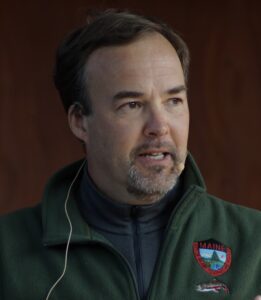
Matthew Dickerson
Author
Matthew Dickerson’s books include works of spiritual theology and Christian apologetics as well as historical fiction, fantasy literature, explorations of the writings of C.S. Lewis and J.R.R. Tolkien, and books about trout fishing, fly fishing, rivers, and ecology. His recent book,