


The Ongoing Journey of Getting Older
Years ago, when I first started thinking about getting older, I assumed that if I read about it, thought about it, and talked about it, I would be all set to live happily ever after. I knew my life would change: a smaller house, fewer professional opportunities, and maybe less travel. Nothing I couldn’t handle.
But instead of living happily ever after, I found myself wandering around in the ever-changing landscape of getting older. As a younger person, I thought about the things on the outside of me that would change with age. I didn’t realize that the biggest and most difficult changes would be on the inside. I didn’t realize that I would face new, inner challenges living with my aging body, new questions about how to accept the disappointment of unfulfilled expectations for myself, and even new questions about what God expects of me. This is much harder than I thought it would be!
I didn’t realize that the biggest and most difficult changes would be on the inside.
If I am honest, I do like some of the things that are happening in the liminal spaces of this season of life. I am more content and less driven. I am more flexible and less rigid. Some of the broken places in my life have been healed, physically and emotionally. And I am slowly learning to let go of ideas, responsibilities, and accomplishments that I thought were mine forever. With the benefit of Holy Hindsight, I can see that God has not let a day go by “without his unfolding grace” (2 Corinthians 4:16, MSG). Some days, I even like the older me better than the younger me.
Waiting for Grace
The problem is that I am disappointed and impatient waiting for the hidden grace that is still unfolding. On those days, in my mind, I sit with Jesus in the Garden of Gethsemane and pray, “Let this cup pass from me” (Matthew 26:39, NRSV). As I pray, I admit that even though some good things are happening, I really want the changes and challenges of getting older to go away. But God rarely answers my prayers as I would like.
It is a comfort to know that this happened to Jesus, too. God allowed him to experience the worst we can imagine, and then three days later raised him from death. Talk about unfolding grace! This was even more than Jesus’ disciples could imagine. Mary Magdalene couldn’t believe what she was seeing when Jesus came to her at the tomb (John 20:14). Thomas refused to believe that the other disciples had seen Jesus alive again (John 20:24,25). The two travelers on the road to Emmaus did not even recognize Jesus (Luke 24:13-21).
Sometimes I wonder if I am joining this group of doubters when it is hard to believe that God is answering prayer as my body continues to diminish. Even my more energetic friends hit times when their bodies disappoint them. Sometimes this happens with illness. Or broken bones. Or trying to keep up with others’ expectations. Most of us, as we age, find ourselves asking, “Why can’t I do what I want to do? Why can’t I do what I used to do?” Why, we ask, do our bodies so often keep us from living the life we long for?
Worshipping God as We Age
It surprises me, then, that Paul wrote to the Romans, “By the mercies of God, . . . present your bodies as a living sacrifice, holy and acceptable to God, which is your spiritual worship” (Romans 12:1, NRSV). Worship? Really? With this body? What does “worship” mean as my body keeps getting older?
Presenting my body as a living sacrifice is not my familiar definition of worship. When I was younger, worship meant that I went to church on Sunday mornings to attend a “worship service” with a printed bulletin telling us the exact order of events. What could Paul have meant by calling it “worship” to present our bodies to God? Where is the bulletin with the order of events?
As I muse on this, God is expanding my understanding of what it means to worship. I was worshipping God in my childhood church with its carefully choreographed order of worship. These days, I am invited to worship God with the liturgy of the church I attend. I am also worshipping God when I am alone, listening to God whisper to me through Scripture. We worship God when we praise him for his love, mercy, and goodness to us. It means, as some commentators say, that we worship God when we agree with him about how he is working in our lives. As I am getting older, I am trying to learn to worship God by saying yes to what is happening in my body.
The Temple of God
In his letter to the Corinthians, Paul reminds us how important it is to worship God by agreeing with him about what is happening in our bodies no matter how old we are. “Do you not know,” Paul wrote, “that your bodies are temples of the Holy Spirit, who is in you, whom you have received from God? You are not your own; you were bought at a price. Therefore honor God with your bodies” (I Corinthians 6:19,20, NIV).
I memorized these verses in college, assuming that they were telling me not to be immoral or do drugs. Now I am seeing so much more in Paul’s words. God is inviting me to remember that my body is a temple, the Spirit lives in me, I do not belong to myself, and I can actually honor God with my body in this season of life.
The body, at every age, is a temple of God. The Holy Spirit continues to live in my body, even if it is sick, tired, or disappointing. I did not put the Spirit there by my good works, holy hopes, or impressive activities. The presence of the Spirit in me is a given, whether I feel God’s presence or not. I am to honor God by taking care of my body, a temple where the Spirit abides.
The body, at every age, is a temple of God.
The invitation to worship God with our bodies is one of the most common, perhaps most unnoticed invitations of growing older. We have spent our lives thinking that our bodies belong to us—to use, to take care of, and even to display. But as I get older, I find that I am less in charge of my body. Getting older is a vivid reminder that my body does not belong to me. I am not entitled to the strength, abilities, and appearance that I used to have. I am also not entitled to be able to do all the important things I used to do. To accept that I am not in charge of my body is difficult but freeing. I need to learn more about what it means to present my body as an act of worship to God.
Robbers in the Temple
Even though the gospel account of Jesus cleaning out the temple happened long ago, in a different culture, it speaks to me about taking care of my body, my own personal temple. According to Luke, Jesus stormed into the temple, turned over the tables and said, “The Scriptures say, ‘My house should be a place of worship.’ But you have made it a place where robbers hide!” (Luke 19: 46, CEV). As I age, I am noticing that there are robbers hiding in my temple. We all have different bodies, different temples where the Holy Spirit lives, and, I believe, different places for robbers to hide.
My own robbers hide in my expectation that every morning I can hit the ground running, as I did in my younger days. My robbers crouch behind my false belief that if I just try harder, I can get more done each day. My robbers blame me for being weak, inadequate, and so old. The robbers in my temple are not telling me the truth. And they are robbing me of peace.
Before Jesus went into the temple, he wept for the people of Jerusalem. “If only you, even you,” he cried, “had only recognized on this day the things that make for peace!” (Luke 19:42 NRSV). Jesus’ tears make me wonder if I, too, am missing ways that God wants to give me more peace.
Jesus’ tears make me wonder if I, too, am missing ways that God wants to give me more peace.
Making Room for Peace
Jesus went into his local temple and threw over the tables of “people selling animals for sacrifices” Luke 19 45 NLT). I do not sell animals, but in my imagination, I picture Jesus coming into my temple. If Jesus threw over my tables, I can guess some of the things that would tumble to the floor – my to-do lists, my calendar of obligations that may or may not be from God, all the books and articles I want to read, my cell phone and all the emails in my inbox I want to answer. There is nothing wrong with any of these things, but they rob me of peace when I compulsively try to respond to all of them as soon as possible. And, even worse, they rob me of peace when I assume that I need to do all these things as “sacrifices” for God, sounding a lot like the sellers in Jesus’ local temple.
As I muse on Jesus in the temple, I find myself picturing not ancient merchants but a group of senior citizens who are hoping to be able to worship God as their bodies age. The things on each table are different, but I am coming to believe that each of us would do well to clean out things that do not bring peace to us or honor to God. Jesus’ tears in Jerusalem and his anger in the temple remind me that as we age we are invited to listen carefully to the whispers of the Holy Spirit within us, offering us new ways to worship God and experience peace.
The whispers of the Spirit will be uniquely suited to each of us. The Spirit seems to whisper holy invitations to me, especially in the morning. (Perhaps that is when the Spirit is most likely to have my attention.) I want to jump out of bed and begin the rush to accomplish all the tasks of my day.
But the Spirit is inviting me to be still—and not even pick up my phone until my aging body and brain are fully awake. In the stillness, I do not read as many books or commentaries as I used to. Instead, I try to listen to truths God has already taught me. The word “remember” is used hundreds of times in Scripture, so I try to sit still and remember. One of my favorite verses to remember is from Isaiah: “The Sovereign Lord has given me a well-instructed tongue, to know the word that sustains the weary. He wakens me morning by morning, wakens my ear to listen like one being taught” (Isaiah 50:4, NIV). I would like to live the rest of my life noticing what God is saying to me in the morning and praying that I will be able to love others in the way that he instructs me. When I can do this, there is peace in my soul.
May God help all of us all to listen carefully, day by day, to the Spirit within us, loving us and extending grace and peace to us that we can then extend to others. This is one of the holy invitations of growing older.
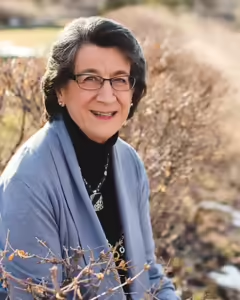
Alice Fryling
Author & Director
Alice has been a spiritual director for 25 years and is the bestselling author of ten books on relationships and spiritual formation. Her most recent book is Aging Faithfully: The Holy Invitation of Growing Older. Learn more at