


In the Beginning God
Scripture — Genesis 1:1-5, 2:1-3 (NRSV)
In the beginning when God created the heavens and the earth, the earth was a formless void and darkness covered the face of the deep, while a wind from God swept over the face of the waters. Then God said, “Let there be light”; and there was light. And God saw that the light was good; and God separated the light from the darkness. God called the light Day, and the darkness he called Night. And there was evening and there was morning, the first day. . .
Thus the heavens and the earth were finished, and all their multitude. And on the seventh day God finished the work that he had done, and he rested on the seventh day from all the work that he had done. So God blessed the seventh day and hallowed it, because on it God rested from all the work that he had done in creation.
Read all of Genesis 1:1-2:4 here.
Focus
Why is this important—both that the Trinity exists, and that the Trinity acts?
Devotion
This coming Sunday is Trinity Sunday, which in the Western church is always celebrated the Sunday after Pentecost. (I discovered recently when writing a guide to the liturgical year that in the Eastern church both Pentecost and Trinity are celebrated together on the same Sunday.) As far as I can tell, I’ve written about Trinity Sunday at _Life for Leaders _in 2020, 2022 (also here), and 2024, but there are probably more, because I tend to use the phrase “Triune God” a lot, and so searching for it at the Life for Leaders website pretty much surfaces every devotion I have ever written.
The word “Trinity” does not appear in the Bible, of course, so each of the three years of the lectionary, the compilers call our attention to different Scripture passages where we can see the Triune God at work. It was exactly these passages which the fourth-century church was trying to make sense of when they convened the Council of Nicaea and gave to us language which we still use to talk about a God who is Three in One, One in Three, Father, Son, and Holy Spirit.
The work of the Trinity starts at the very beginning of the Bible, where we see Father, Son, and Holy Spirit all active in creation. (The lectionary reading for today actually includes all of Genesis 1, and I encourage you to read the entire thing.) Translations differ, but in the NRSV (which is what is used above), we read of “a wind from God [that] swept over the face of the waters” (1:2) and of God saying in the plural “Let us make humankind in our image, according to our likeness” (1:26). In addition, early readers of Scripture compared this passage from the Hebrew Scriptures to John 1:1-3 and testified to Christ’s presence at creation as the Logos or Word: “In the beginning was the Word, and the Word was with God, and the Word was God. He was in the beginning with God. All things came into being through him, and without him not one thing came into being.”
Why is this important—both that the Trinity exists, and that the Trinity acts? By framing the very act of Creation as an act of the Triune God, the Bible shows us that God was fully God from the very beginning. The Son and the Spirit are not later, and somewhat lesser, add-ons to the Father, or simply convenient ways of explaining how the Father acts. There’s a famous diagram that has often been used to explain this (this is an older version because it’s public domain, but you can easily find ones with more up-to-date fonts by Googling.)
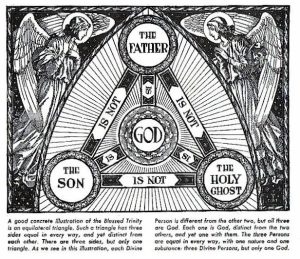
And why is that important? Because we find it very easy to limit God. The Trinity reminds us that from the very beginning of this created universe, the relationship within the Godhead has been one of mutual, self-sacrificial, infinitely creative, self-giving love. Imagine how we could change the world if that was what we thought about every time we said the word “God”—and if that was the way we believed, led, and followed in response.
Reflect
Do you find that you relate more naturally to one of the Persons of the Trinity? Which one?
How can you experience God as fully Triune?
Act
There has been a longstanding hymnwriting tradition in which each verse talks about the attributes of One Person of the Trinity and then the hymn closes with a doxology to God as Triune. There are many hymns which follow this pattern, but one of my favorites is “Come, Thou Almighty King.” Ponder the questions above as you listen.
Pray
(Prayer for Knowledge of God’s Creation in the Book of Common Prayer)
Almighty and everlasting God, you made the universe with all its marvelous order, its atoms, worlds, and galaxies, and the infinite complexity of living creatures: Grant that, as we probe the mysteries of your creation, we may come to know you more truly, and more surely fulfill our role in your eternal purpose; in the name of Jesus Christ our Lord. Amen.
Find all Life for Leaders devotions here. Explore what the Bible has to say about work at the unique website of our partners, the Theology of Work Project. Reflection on today’s Life for Leaders theme can be found here: God Works to Create the World (Genesis 1:1-25).

Jennifer Woodruff Tait
Author of Life for Leaders Devotions
Jennifer Woodruff Tait (PhD, Duke University; MSLIS, University of Illinois; MDiv/MA Asbury Theological Seminary) is the copyeditor of and frequent contributor to Life for Leaders. She is also senior editor of