


Navigating Liminal Space as We Age
I was four years old when my family moved from Ohio to Maryland. Every summer after that, we drove back to Ohio for a visit. There were no turnpikes, no rest areas, no GPS. I was restless and anxious as I sat in the backseat of our 1950s blue Hudson. I must have asked dozens of times, “When will we get there?” And with even more anxiety, “What happens if we get lost?”
My anxiety on those back roads foreshadowed what I would feel in the liminal spaces of moving between childhood, midlife, and my senior years. Simply put, liminal space is the mysterious place between where we are and where we are going, whether literally or metaphorically. In the liminal space of aging, most of us live into emotional, relational, and spiritual places that are new to us. Like Abraham in the Old Testament, God is inviting us to a new land (Genesis 12:1). And like Abraham, we may not know where we are going (Hebrews 11:8).
In the liminal space of aging, we probably have many questions: “How long will I live? What if I run out of money? What will happen if I get sick?” Or we might ask, as I often do, “Can I still love and serve others now that I don’t have a job description? Will I have enough energy to do that? What will others think of me as I keep diminishing?”
It is difficult to live with so many fears and questions. On my hardest days, all I can say is, “God, please help me!” More often than not, God’s help comes to me through Scripture. Many of the verses the Holy Spirit whispers to me are familiar ones. Others are new, or are in new translations. But all of them are “living and active. . . able to judge the thoughts and the intentions of the heart” (Hebrews 4:12, NRSV).
This is just what I need in my own liminal space! I am paying special attention to what God’s words are teaching me about getting older.
Changing Our Way of Thinking
Paul wrote to the church at Ephesus, “Let the Spirit change your way of thinking” (Ephesians 4:23, CEV). He wrote to the Romans, “Offer your bodies to him as a living sacrifice. . . let God change the way you think. Then you will know how to do everything that is good and pleasing to him” (Romans 12:1–2, CEV).
It is especially significant for those of us who are aging that Paul includes the body along with his advice about the mind. Part of the liminal space as we age is that our diminishing bodies often do not cooperate with the plans of our minds. In the amazing alchemy of God’s grace, as our bodies are getting weaker, we are often more motivated to pray for the “renewal” of our minds. We need a new way of thinking to live within our bodies in this season of life.
Part of the liminal space as we age is that our diminishing bodies often do not cooperate with the plans of our minds. In the amazing alchemy of God’s grace, as our bodies are getting weaker, we are often more motivated to pray for the “renewal” of our minds.
This will look different for all of us. God’s particular invitation to me is to change the way I think about prayer. Almost every day, I think I know what I should do and what God expects of me. I ask God to give me the energy, opportunity, and ability necessary to fulfill the expectations I have for myself that day.
In the liminal space of getting older, God rarely answers my prayers by giving me what I think I need. Instead, he is changing the way I think. He guides me to pray with holy detachment. Each morning, I try to sit quietly with my hopes for the day, waiting long enough for God to sort out my thinking about these desires. And then, I sit and wait until I can let go of the expectations that are not appropriate for my aging body.
In the liminal space of getting older, God rarely answers my prayers by giving me what I think I need.
I still have a long way to go as I journey through this portion of the liminal space of getting older, but I am beginning to have a deeper sense of surrender. I find myself praying, as Jesus did on the cross, “Father, I place my life in your hands!” (Luke 23:46, MSG).
Responding to God’s Giving
Jesus said (to his disciples and to us), “What I’m trying to do here is to get you to relax, to not be so preoccupied with getting, so you can respond to God’s giving” (Matthew 6:30-33, MSG).
In this season of my life, I am downsizing my books, my clothes, and other things around my house that I no longer need. Every time I walk into a store, I think about how I do not want to get any more stuff! I hear in Jesus’s words an additional invitation to downsize my desires to get validation through what I can accomplish—to “cease striving” (Psalm 46:10, NASB).
Years ago, I learned from the Enneagram that when we are under stress, we are tempted to overplay the gifts that God has given us. This is what I do when I experience the stresses of growing older. I want God to help me use my gifts beyond my current capacity. I face this temptation every day.
When this happens, the Spirit reminds me once again to stop trying to get more opportunities or more affirmation, and instead, to respond to God’s giving. There is nothing I can do to make God or others love me more or, for that matter, love me less. I need a very simple way to relax and rest in the grace and love God is already giving me. God’s invitation to me is to return to the experience of breath prayer.
I have prayed with this ancient form of prayer before, but I am finding that in this season of life, it is an especially good way to rest in the freedom of God’s love. It is simple. It is short. And it reflects the Genesis account of Creation—an early example of liminal space. When God formed Adam, he “breathed into his nostrils the breath of life; and the man became a living being” (Genesis 2:7, NRSV). In my own experience of growing older, God is breathing new life into my soul.
Helping Our Bodies and Souls Relax
When the losses that come with age discourage us, and fears of the unknown overwhelm us, God invites us to stop, sit down, and breathe deeply. Breathing deeply restores equilibrium to our minds and bodies. When we include Scripture with our breathing, we are also restoring a holy balance in our souls. No matter how old we are, we can sit quietly, breathing in and out deeply, while remembering a promise from God that speaks to us at the moment.
For example, we might embrace God’s love and truth like this:
- John 14:27 — Breathing in: Peace I leave with you; my peace I give to you. Breathing out: Do not let your hearts be troubled, and do not let them be afraid.
- Isaiah 46:4 — Breathing in: You have carried me from my birth. Breathing out: Even to my old age, you will carry me.
- Psalm 139:14, 16 — Breathing in: I am fearfully and wonderfully made. Breathing out: In your book were written all the days that were formed for me.
There are, of course, many ways to practice breath prayers, and any number of verses to choose from. But praying this way, however we choose to do it, helps restore equanimity in our bodies and our minds. When we do this as often, and for as long as we need to, our souls will begin to relax and rest in God.
Focusing on What Is True
Jesus went on to say (again to the disciples and to us), “Give your entire attention to what God is doing right now, and don’t get worked up about what may or may not happen tomorrow. God will help you deal with whatever hard things come up when the time comes” (Matthew 6:34, MSG).
As I get older, I am prone to return to my habit of worrying about the unknowns of tomorrow rather than living in the mysteries of today. Jesus could have been speaking to me when he said, “Steep your life in God-reality, God-initiative, God-provisions. Don’t worry about missing out. You’ll find all your everyday human concerns will be met” (Matthew 6:32–33, MSG).
These words give me an idea of what to focus on as I age. I can ask myself:
What is the reality of the energy and opportunities God is giving me today?
What initiative does God want to take in me and through me?
What might God want to provide for me today?
When I let myself “steep” in the truth about who God is, I remember that he will meet me in all my concerns for the day.
Learning to Listen to the Holy Spirit
David wrote, “Even though I walk through the darkest valley, I fear no evil; for you are with me” (Psalm 23:4, NRSV). This is a comforting but mysterious truth as we experience the liminal space of aging.
Even though we walk through some very dark days, we do not need to be afraid, because God is with us. The mystery is that even if we believe that God is with us, we do not see him.
This happened to disciples who walked to the village of Emmaus after Jesus died. Jesus met them on the road, but they didn’t recognize him. He talked with them and even ate with them. When their eyes were opened and they finally recognized him, Jesus “vanished from their sight” (Luke 24:31, NRSV).
God is with us whether we know it or not. Or, as some people say, God may be silent, but he is not absent.
One of the reasons we may not recognize that God is with us is because we are looking in the wrong places. We are looking outside ourselves toward circumstances, results, or the opinions of others. In the liminal space of growing older, God invites us to look for truth and guidance not around us, but within us. God delights “to see truth deep within me; You teach me wisdom in the hidden places of my spirit” (Psalm 51:6, First Versions Bible).
As older people, we have lived a lot of life. We have a lot of wisdom planted deep within us, and we may even know a lot of Scripture. In this liminal space of our old age, we may worry that God is silent. But with this season of life comes a special invitation to listen to the whispers of the Holy Spirit within.
Jesus taught that the “Spirit of truth. . . abides with you, and he will be in you” (John 14:15, NRSV). He also said that the greatest commandment is to “love God with all your heart, and with all your soul, and with all your mind” (Matthew 22:36–37, NRSV). These are all places within us where God is at work, even as we age.
Now is the time to learn to listen to the silence of the Holy Spirit, the sighs that are “too deep for words” (Romans 8:26, NRSV). God invites us to do this by noticing what we are thinking, feeling, and remembering—to grow more and more alert to how God is working in us and through us.
As our bodies diminish, we can experience a renewed holy strength in our souls. Paul wrote, “Even though our outer nature is wasting away, our inner nature is being renewed day by day” (2 Corinthians 4:16, NRSV). And in this liminal space, on a journey full of unknowns, “Not a day goes by without his unfolding grace” (2 Corinthians 4:16, MSG).
As our bodies diminish, we can experience a renewed holy strength in our souls.
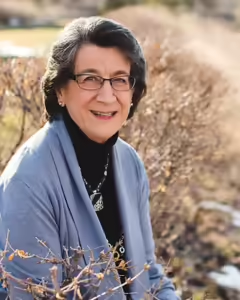
Alice Fryling
Author & Director
Alice has been a spiritual director for 25 years and is the bestselling author of ten books on relationships and spiritual formation. Her most recent book is Aging Faithfully: The Holy Invitation of Growing Older. Learn more at