


Revisiting the Enneagram as We Age
Now that the celebration of my eightieth birthday is history, I am revisiting the Enneagram. I went to my first Enneagram workshop in my early fifties. As I look at the Enneagram again, decades later, I want to see if I am still a Number Four, as I first saw myself on the Enneagram diagram, or if I am now defined by the number 80, as in an eighty-year-old grandma. I am finding that I am still a Number Four, but now that I am older, I live in the Number Four space a little differently. (If you’re new to the Enneagram, you can learn more here.)
Some people learn about the Enneagram long before they enter their senior years and carry the perspective of the Enneagram into their life experiences as they age. Others are new to the principles of this tool for self-awareness and find it helpful in understanding who they are becoming as they get older. But all of us can benefit from taking a fresh look at this ancient paradigm as we get older, when so much seems new, even though we have become old.
Looking back
When I went to that first workshop, I learned that the Enneagram identifies nine different gifts that human beings have been given. Under stress, we are tempted to exaggerate our particular gift in order to impress others in situations and relationships that are difficult for us. We may even become compulsive about trying to hide our perceived weaknesses behind our gifts. Thankfully, the Enneagram also suggests the graces God offers to help us move towards a healthier perspective.
The temptation to hide behind our giftedness continues as we experience the stresses of growing older. I am wondering, then, if I might need to change how I live with my gifts. Am I exaggerating my gifts in the ways I did as a younger person? What do I do about the diminishing gifts that used to bring validation? How am I trying to use my gifts to deny to myself and others that I am not really that old? With each decade of getting older, I have less energy and less opportunity to continue this game of hide and seek. I am thankful that the wisdom of the Enneagram continues to help me respond to the questions that come in this season of life.
The Triads of the Enneagram
The Enneagram divides the nine spaces of its paradigm into three categories: the head, heart, and gut triads. Interestingly, these are the very places I am experiencing diminishment as I get older. My mind works more slowly than it used to. When I feel discomfort in any relationship, it weighs heavier in my heart. And my body is slower, less resilient, and gets tired more often than it used to.
As I review the triads, I am noticing that the words used to describe each triad help me understand many of the problems I am experiencing now. Even though the triads divide the spaces into three different categories, most of us visit every triad as we live out our lives. I can learn, then, from the descriptions of all three triads.
People in the Heart Triad (Numbers 2, 3, and 4) are instinctively pulled towards relationships and other people. They often get stuck in anxiety when they feel overly responsible for other people and situations. This anxiety may lead them to compare themselves with others, for better and for worse. When they hide behind their gifts, they may sacrifice reality for harmony. But in moments of graced honesty, they realize they do not have to fix the problems of the world and can be content to simply be who they are.
People in the Head Triad (Numbers 5, 6, and 7) observe others and life. They take in information and hold it inside. It is often difficult for them to take action because they feel they never know enough. This may grow into a fear that leads them to compulsively try to organize their inner world. Fear can also lead them to retreat or to feel forgotten and overlooked. God invites them, over a lifetime, to learn to experience life without always understanding it.
People in the Gut Triad (Numbers 8, 9, and 1) respond instinctively and forcefully to the present moment, often with opinions and judgment. They may find themselves angry and wonder why. Their anger probably grows out of their desire to compulsively control their inner and outer worlds. As they learn from God’s grace that they don’t need to control circumstances and other people, they begin to look at life and themselves with less judgment. (For a more complete description of the triads and the spaces of the Enneagram, along with the wings and the arrows, see my book, Mirror for the Soul.)
The Enneagram as We Age
Engaging with the descriptions of the triads, as well as the individual spaces, offers us discernment about how our gifts might be helping us or hindering us as we age. Even though we stay in the same triad and Enneagram space, we will embrace the truths of the Enneagram differently in the different decades of aging.
In our sixties, for instance, we are likely to appreciate the self-awareness the Enneagram offers, even as we continue to be enamored with our gifts and try to use our gifts to hide our weaknesses. As we move into our seventies, we begin to experience more of the losses that come with age. If we are honest, we admit that we still want to hide behind our gifts but the demands and compulsions of our giftedness interfere with our capacity to “age faithfully.” In our eighties, we may begin to think we no longer want to play this game of hide and seek, but we don’t know how to stop.
Teachers of the Enneagram often use the word “compulsions” to describe the temptation to overplay our gifts. We have probably wanted to deny these compulsions for decades. This is why it is so helpful to see the connection between the stresses of growing older and our Enneagram inclinations.
For instance, I struggle with anxiety. It takes a lot of quiet reflection for me to admit that much of my anxiety is connected to my heart triad propensity to feel responsible to meet the problems I can see in other people’s lives. My default position is to take care of others before I take care of myself.
I also join those in the head triad when I am afraid that I don’t know enough to understand what is happening to me as I age. This fear can sit in my mind and heart for days while I worry about the changes in my life and my body.
And, of course, I can also join with those in the gut triad and be angry that people don’t want my opinions as much as they used to. I am surprised when this anger spills over into my relationships, but I can’t seem to stop it.
These compulsive responses take a lot of energy—something I don’t have a lot of! When I get tired, my aging body is telling me something. But I struggle to accept the messages of my body and so many of the other diminishments of getting older.
Resistance to Letting Go
Sadly, when I resist what my changing body is telling me about the fatigue and frustration of trying to use and overuse my gifts, I am also resisting God. How could God allow my body to fail me when I have served God so well? My to-do lists become the Ten Commandments for my life. What does God expect of me now that I can’t seem to use my gifts as I used to? How do I know what to do and what not to do?
Jesus hinted at the kinds of questions we ask when he said, “You’re blessed when you’ve lost it all. God’s kingdom is there for the finding” (Luke 6:20, MSG). Perhaps as we age, we don’t have room for our gifts and for learning more about how to experience God’s kingdom in our lives. But my sense is that God is not expecting us to completely let go of our gifts. More likely, he is inviting us to hold our giftedness more loosely, with a sense of “holy detachment.”
To live with holy detachment about our gifts means that we let go of worrying what others think of us and of knowing what our gifts are accomplishing. This kind of holy detachment is a radical change in thinking for me. I need to remember what Paul wrote in Ephesians: “Let the Spirit change your way of thinking” (Ephesians 4:23, CEV). He wrote to Peter: “Live carefree before God; he is most careful with you” (I Peter 5:7, MSG). Living well in my Enneagram space may be getting harder as I age.
The Enneagram and Transformation as We Age
I have lived as a Number Four all my life. Now I am resisting idea of changing the way I think, and I can’t imagine “being carefree” about life. Revisiting the Enneagram is helping me understand in a personal way what God said in the Book of Isaiah:
“Only in returning to me and resting in me will you be saved. In quietness and confidence is your strength. But you would have none of it. You said, ‘No, we will get our help from Egypt. They will give us swift horses for riding into battle’” (Isaiah 30:15-16, NLT).
I want to rest in the quietness and confidence God offers as I age, but I admit that I sometimes choose to do battle with old age by returning to “Egypt” and riding away on the familiar swift horses of my younger years, including the way I use my gifts.
Thankfully, God is merciful. Isaiah went on to say, “The LORD must wait for you to come to him so he can show you his love and compassion. For the LORD is a faithful God. Blessed are those who wait for his help” (Isaiah 30:18, NLT).
In other words, God is waiting for me to wait for him. In Enneagram terms, God is waiting for me to come to him for transformation from a compulsive Number 4 into someone who finds quietness and confidence in his love. This is a very slow process indeed. My prayer these days is:
“Create in me a clean heart, O God, and put a new and right spirit within me. Do not cast me away from your presence, and do not take your holy spirit from me. Restore to me the joy of your salvation, and sustain in me a willing spirit” (Psalm 51:10-012, NRSV).
God is answering my prayer by gently transforming me, gently giving me a new heart, and granting me a willing spirit. By the grace of God, I am slowly learning to receive transformation in my giftedness, in my motivation, and in the inner experience of God’s kingdom.
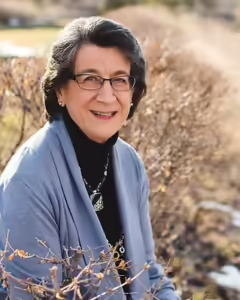
Alice Fryling
Author & Director
Alice has been a spiritual director for 25 years and is the bestselling author of ten books on relationships and spiritual formation. Her most recent book is Aging Faithfully: The Holy Invitation of Growing Older. Learn more at